MATTEO MELIOLI
OSX
OXFORD CIRCUS

Located in the heart of the West End, Oxford Circus is a road junction between Regent Street and Oxford Street, one of Europe’s busiest shopping street with approximately half a million daily visitors and more then 300 shops[i]
The junction opened in 1819 as part of the Regent Street development underJohn Nash, and it was redesigned around a series of four quadrant buildings by Henry Tanner between 1913 and 1928.
The arrival of improved transport links in the Edwardian period extended Oxford Street’s appeal to shoppers, securing its status as the capital’s most continuously successful shopping street. Oxford Street was serviced by a range of underground lines connecting to four stations at Tottenham Court Road, Oxford Circus, Bond Street and Marble Arch. The Central Line was opened in 1900, followed by the Bakerloo Line in 1906. In the following year, the Northern Line opened at Tottenham Court Road. In 1969 the Victoria Line opened at the newly remodelled Oxford Circus Station, boasting a new concourse accessed from each quadrant of the circus. With the impending arrival of the Elizabeth Line, connections will be further improved [ii]

THE MAKING OF OXFORD CIRCUS
After the pandemic, big names have disappeared (Topshop, Debenhams, gap, French Connection and Carphone Warehouse) while others have reduced their size, converting same of their space into offices and leisure facilities (Mark and Spencer, John Lewis)[i].
This is symptomatic of a point of crisis driven by the pandemic and by the street’s devotion to almost exclusively retails. With exception for restaurants into the department stores, there is only one pub and just few dining outlets facing the street.
(Jace Tyrrell chief executive of NWEC) suggests to build a more European approach with food and drink services, entertaining, seating and greenery servicing offices above, flanked by residential areas.
Traffic has to be reduced and pavements have been widened in the recent years, this is to reduce the endemic problem of too many public buses running through the street.
The traffic problems seem to be endemic: witnesses to a royal commission in 1903, complained that there were too many buses on Oxford Street, proposal for improvement have varied from 1960 plans for a deck above the street to carry shoppers via a travelator and a 1970 scheme for a track carrying cars on an air’s cushions, to a numerous call for a full pedestrianisation, the last one felt particularly needed with the opening of the Elisabeth Line bringing in shoppers from further away.
The last of the proposal is a pedestrian piazza which would only allow the traffic flow down Regent Street, as opposed to for different directions in the current layout[ii]. By creating a landscaped piazza, the idea was to attract shoppers on the street and making the space car free enhancing the shopping experience.
Worth to be mentioned is the masterplan proposal, not for Oxford Circus itself but for the area identified as the East End of Oxford Street. In his proposal, a cluster of 4 buildings running along Tottenham Court Road and Charing Cross Road are sculpted and shaped to create a continuous building. It is intended that these 4 buildings create a new gateway and architectural possibility, as the centrepiece to the redevelopment hub. Atriums are introduced on the corner to allow the public space outside the building to relate to the interior, reducing pavement congestion. A connection to the underground station is provided at the basement level and upper levels are liked by passageways and bridges, turning the 4 parts of the buildings into a connected floorplate.

Ground Floor proposal

Garden Floor proposal

Functional Diagram
DESIGN PROPOSAL
Oxford Circus denotates the heart of Central London. It benefits from its position on a north to south and eat to west axis providing pivotal accessibility to all parts of Central London via road and underground.
The aspiration is to develop a proposal for this strategic site, comprising a mixture of uses including retail, offices leisure and ancillary uses, which are to be complemented by a series of public spaces and improved local environs and transport infrastructure. The area is thus to become a new destination in its own right for retailing, living, working, and tourism.
The extent, balance, nature and location of uses is yet to be determined but it is anticipated that the ground and lower floor levels will provide for a mixture of retail including shops, flagship stores, cafés, restaurants, and bars. The upper levels will be a mixture of office and leisure uses. Establishing the right balance of uses will be essential to ensure that the area is as active and vibrant as possible throughout the day, and to help to develop a new destination in the core of London.
The vision is to draw upon the success and footfall characterising those areas to the West of Oxford Circus, Soho and Covent Garden. It is not necessarily intended for the new destination to compete with the uses and character of these areas but to compliment them and establish a new quarter in the West End.


Change the way of shopping:
In shops, the glass windows and the walls separate the retail from the public space, besides being a ‘boundary, walls and windows are also the first commercial interface between potential customers and retailers, hence the tendency to maximise them.
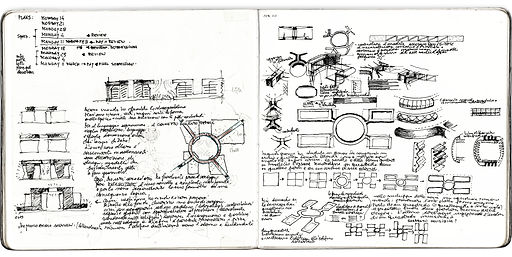
The vision is to think again the relationship between the commercial floorplate and its public surrounding, by mixing them and creating large ground floor spaces where public can circulate freely. In addition, the retail is detached from its structural envelope (like a building in a building) and the space between allows more permeability including connections to the underground station underneath.
The retail ground floor will look like an open, 8-meter-high space where commercial stands and green zones blends together and crate a sort of ‘garden retail’ like a continuation of the pedestrian floor into the shop.
The last floor of each quadrant is connected by a ring, cantilevered above the circus. The ring allows a free circulation among the 4 blocks and it is also used as platform view, in an attempt to combine functionality and attract shoppers and visitors[i]. The last level is landscaped to look like a floating garden, a green space recovered above the building itself and open to the sky. Large sections of the floors are glazed, leaving the light to penetrate to the lobby below and, by walking on the glass, the feeling of floating above the void. Restaurants and other leisure’s activities are located at this level, and they work independently from the rest of the building.
[1] https://www.theb1m.com/article/marble-arch-mound-mvrdv-london
[2] https://blogs.ucl.ac.uk/survey-of-london/category/oxford-street/
[3] https://blogs.ucl.ac.uk/survey-of-london/category/oxford-street/
[6] https://www.theb1m.com/article/marble-arch-mound-mvrdv-london