MATTEO MELIOLI
RESEARCH WORKS I DRAWING of the YEAR 2024
OXFORD CIRCUS

Located in the heart of the West End, Oxford Circus is a road junction between Regent Street and Oxford Street, one of Europe’s busiest shopping streets. The junction opened as part of the Regent Street development under John Nash, and it was redesigned around a series of four quadrant buildings.
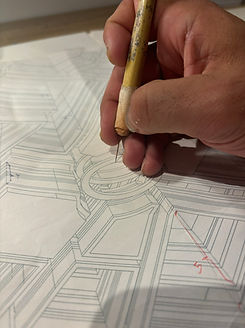
In my conceptual drawing, I represent the quadrants and the surrounding buildings as empty blocks, to emphasize the role played by their interconnected volumes. The drawing uses layers and colours to differentiate the blocks and offer a sense of stratification, in response to the long architectural history of the site. At the centre of the quadrants, I represent a ‘Ring’, intended as a platform suspended above Oxford Circus that connects the four quadrants. The platform offers a view on both Oxford Street and Regent Street and improve their connectivity, adding retails and mixed used facilities to the area.
Oxford Circus, pastel and ink on pressed paper, 70x80 cm
OxfordCircus opened in 1819 as part of the Regent Street development under John Nash, and it was redesigned around a series of four quadrant buildings by Henry Tanner between 1913 and 1928. The arrival of improved transport links in the Edwardian period extended Oxford Street’s appeal to shoppers, securing its status as the capital’s most continuously successful shopping street.
In 2021, after the pandemic, big names have disappeared while others have reduced their size, converting same of their space into offices and leisure facilities. Hoping to boost domestic tourism and to help speed up the return of shoppers to Oxford Street, the Westminster City Council appointed MVRDV’s design for a landmark ‘Hill’ to be built next to the Marble Arch. The design was aimed to provide a panoramic view of London and of the nearby Oxford Street. Sadly, the Hill met oppositions, unpopularity and eventually it closed and was dismantled just few months after its construction.
What the Hill proposal tells us is that the idea of a panoramic view over Oxford Street was successful, but the choice of the site was a wrong one. Deriving from this, my design proposes instead a platform suspended above Oxford Circus, a loop that connects the four quadrants. The platform offers a view on both Oxford Street and Regent Street and improve their connectivity, adding to the area a considerable amount of mixed use space.
The design also suggests a complete overhaul of the four quadrants, converted into office spaces and retail departments stores, The quadrants are connected to the tube station below ground, from which it is possible to access the department stores and by lift or escalator to reach the roof gardens connected by the suspended platform.
The roof gardens are a space for nature, leisure and relaxations, they are a sort of ‘urban’ forest where to find entertainment and escape from the buzzling life of the city below. The gardens are connected by the suspended ring, offering a view of all the four main streets and connecting different areas within the gardens themselves.


Study sketches from Notebook, pencil and ink on paper 18x18