MATTEO MELIOLI
FORSAKEN VENICE
Melioli Matteo
Bartlett School of the Built Environment, London, UK
IUAV, University of Architecture Venice, Italy
INTRODUCTION
Figure 1. Marghera’s chemical park.
When landing at Marco Polo airport, if a traveller gazes out of the right side of the plane, he will catch a glimpse of the unmistakable profile of Venice. In the afternoon sunlight, when the sun's low rays reflect the colours of the lagoon, the city’s sinuous shape seems like a precious pearl set into a delicate filigree of land and water.
Glancing inland, towards the west, at the end of the lagoon a world ends: here an expanse of oil platforms, fields of containers and tanks, dreadful and sublime at the same time, greet our eyes. The undeniable magnificence of these structures contends with Venice for primacy within the city’s own territory [1].
Using this experience as an introduction, I would like to direct the observer towards the industrial landscape laying at the margin of the tourist city. Driven by my interest in no-man's-lands and intrigued by the abandonment of industrial settlements, I would like to accompany the reader inside these plants to encounter the apprehension, anxiety and dismay of these architectures that is found there.
We will enter a space “saturated by man’s technological endeavours, a landscape where […] abandoned warehouses and rusty carcasses replace Poussinesque ruins.”[1] Two myths – the city suspended on the water and the steel factory – overlap along the very same skyline. Domes and containers, bell towers and silos all describe a fragmented space, remnants of a plenitude irrevocably lost.
In this paper, we will see how the abandonment of industrial architectures can be identified with the metaphor of a maimed, aching body, confined to a distance that seems tantamount to a cover-up or kind of removal. While investigating the causes of this anxiety, we will call upon the labyrinthine nature of industrial space, its being a contaminated object in terms of its buildings, as much as it is in the memory of a community who has seen hundreds of its workers die here. Without laying claim to an unequivocal conclusion, this paper will attempt to cast light on a space that is as close to our experience as it is forsaken by memory. The dark industrial outskirts, in Venice like elsewhere, represents a constitutive and necessary condition of contemporary urban space. Like a reversal Campus Martius, which displays what is left uncovered in the decay of Rome’s classical body[2], the industrial areas behind the lagoon become the place where the marginality and otherness which is excluded from touristy Venice is covered. Far from being the displacement of a presence with an absence, voids, darkness, abandonment, lead us directly to sites of crucial disjunctions [3], revealing the historic significance of structures that today’s urban renewal have consigned to the tabula rasa’s oblivion [4].
MARGHERA, THE SITE
Marghera is a vast industrial area located just behind Venice, on the boundary between the mainland and the sea. After a period of over 50 years, during which a series of reclamations ripped land off from the lagoon to build chemical industrial plants, abandonment is now a slow yet irreversible process. Nowadays Marghera's abandoned state fills visitors with a feeling of disarray and absence: Marghera is a land with no future. No one can live there, because the soil is contaminated. No one is willing to restore the landscape to its pre-industrial condition, because the costs would be unsustainable. Nobody can feel any fondness for it, because for decades it caused disease and death by poisoning the community. This state of abandonment turns the industrial icons – chimneys, towers and gasholders – into something now associated with a form of collective shock which, in the case of Venice and Marghera, leads to a spontaneous juxtaposition of historical city and industrial settlement, lagoon and mainland, and so on.
Marghera’s history brings us back to the post-WWI period, when the first industrial settlement was created next to the Lagoon. At that time, Venice’s commercial isolation and demographic growth spurred the extension of the city towards dry land, where several production activities were moved. Marghera’s birth corresponded with the ousting of Venetian industry from the inland towards a remote, inaccessible area. However, this isolation did not hinder industrial expansion, until the great flood of 1966 forced a revision of the petrochemical park’s development plans.[3] From that time on, the plants started being decommissioned, factories abandoned, and what formerly was the largest petrochemical park in the Mediterranean region began to resemble a cumbersome ghost, looming behind touristy Venice which, in turn, has tried to remove its presence ever since.
BODY IN PAIN
Entering Marghera is like descending into a maze of galleries and pipes, buildings that time and abandonment have reduced to thin façades suspended in the sky, stripped out and buried in their own rubble. In presenting these buildings, someone might recall Boullée’s words:
One must present the skeleton of architecture by means of an absolutely naked wall, presenting the image of buried architecture, sinking into the earth, finally forming the black picture of architecture of shadow, depicted by the effect of even blacker shadows.[4]
The echo of these words bring us back to the ruins of a Marghera, as an architecture resembling the death form of a body, shadowed on the ground.[5] By introducing this example, we have associated a building with a developing and decaying organism. Marghera, as a whole, suggests the idea that the petrochemical park is an animate universe corresponding structurally to the human body, a universe of interconnected plants like the organs of a system. This metaphor draws upon an idea which has recurred from the Renaissance to the present day: that an architectural building can be conceived of as an abstraction of the human body. A classical building reflects, in the proportion between its elements, the balance and symmetry which link the different parts of a body.
In Marghera instead, the “architectural body” moves from a condition of ideal, fixed perfection towards a form of instability likened to the dissolution of the unity: the devastation and abandonment typical of the industrial landscape. This loss transforms the body into an unrecognizable juxtaposition of fragments, or the limbs of an aching body, as Elaine Scarry would have defined it.[6] A body no “longer confined to the recognizably human, a body that embraces all biological existence from the embryonic to the mutilated, a body that is no longer the model of unity but the intimation of the broken, the morselated, the monstrous.”[7]
Marghera is a “monstrous” creature, suggesting an association whose origins are rooted in an instinctual fear of the unknown: what deviates from the norm, from stereotype's easy and reassuring taxonomy. Venice and Marghera, in the realm of clichés, perfectly embody this condition: the former seen as a desirable example of harmony and beauty; the latter as an inscrutable land, sublime and horrifying at the same time. The “monstrous” embodied by Marghera unfolds as a fragmented land, a body assembled in the same way as a modern Frankenstein. We can find the sense of this association in the words of Maria Stafford:
One of the lessons of Mary Shelley’s novel is that a wholly original creature, an autonomous thing without precedent, is doomed to the loneliness of absolute freedom without ties. Recall that his basic problem was the fact that he could not find his match, or even someone like him – whether father, mother, or wife. Being so intractably unique, without filiation, he is quite literally impossible to analogize or bring into familiar relationship with the genealogical structure of the universe. This laboratory induced grotesque lived in enforced juxtaposition with strangers.[8]


Figure 3. SAVA Steel Mill Plant abandoned in 1982. Fusina, Marghera.
LABYRITH
Entering the petrochemical park is like entering a labyrinth where the repetition of pipes, plumbing and containers works as a hypnotic device creating perceptual and psychological disturbance. Marghera is an incoherent multitude of buildings eaten away by time, broken down by the years and desuetude. Metal bridges support walkways which penetrate the shadowy plants; tube bundles stream along perpetually parallel, bending in line with the walkways. The horizon is a convergence of pipes, railings, stairs and corridors, obsessively projected towards an infinite vanishing point: it is a horizon which dilates space, which imprisons the observer who becomes impatient to reach the end, only to discover, against his will, that it is a new beginning. Open onto the surrounding lagoon, yet simultaneously closed within its labyrinthine matrix, Marghera suggests an ambiguous space, both expelling and enclosing the observer. The very notion of reality “turns into something revealing itself to be part of another more extensive reality, which nonetheless it also contains.”[i] In some ways, the constant self-reversal can be compared to a digestive process where the image of the double (reversal) and that of transformation (digestion) converge in the structure of Marghera's labyrinthine underground piping. In metaphor’s labyrinth, metaphor suggests the loss of reference points, displacement and doubling; whereas, the digestive process indicates the dynamic and metamorphic nature of the chemical processes taking place in these buildings. As Bachelard has pointed out, in the metaphors of doubled mazes: “the ingested earth moves inside the worm as the worm moves inside the earth.”[ii]
Following Durand,[iii] we notice that the images of the underground hollow in Marghera play a destabilizing role, in that they are related to the image of a sewage system, or to its figurative equivalent, the digestive apparatus.[iv] In the novel Les Misérables, for example, the underground sewers are compared to the city’s belly, where repugnance and hideousness condense. This is how Victor Hugo defines it, as “an obscure, winding octopus… from which plagues gush out... the maw of the dragon which blows hell onto men.”[v] Throughout this description, Durand stated, the moral dregs recall the symbolism of the sewerage, of waste and digestion. This labyrinthine belly, under the dual perspective of digestion and sexuality, is therefore the abyss as a microcosm: the symbol of fear and fall. Connected to that disgust, Durand pointed out that there exists an ethical dualism involving abstinence and chastity: symbols that variously fall back into the image of obsessive repression and purifying ousting; symbols, again, which in Marghera take on the dual contour of abandonment and removal.
The emptiness of the decommissioned plants then becomes a space to hide all the “unseemly” that was left out of touristy Venice. The darkness of the factories quietly digests (or distils) the anguish of the modern urban space, and, along with it, the entire insecurity of a world that is continually consecrated to rationality. On the contrary, the space conceived of as a harbinger of the unseen, embodies the obscurity that withstands control and surveillance.
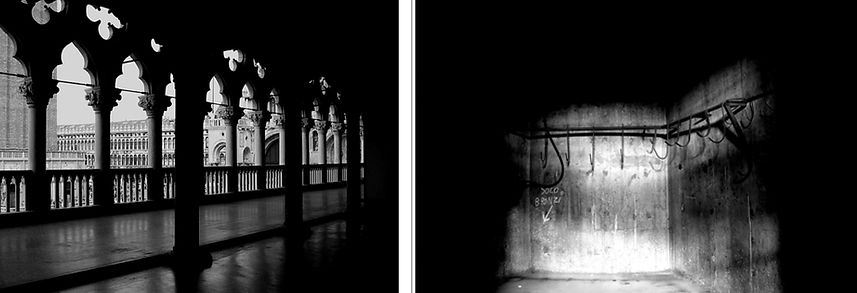
Figure 4, 5. Left: Palazzo Ducale’s first floor gallery, San Marco Square, Venice. Right Storage room at the SAVA Steel Mill, Fusina, Marghera
In other words, Marghera’s dark space challenges and subverts transparency; i.e. that form of sight which “penetrates deep into matter and space, and enables man to cast a simultaneous look even on the opposite sides of the globe.”[i]
At a time when you would not suspect it, the Doge’s Palace – the city’s political and administrative heart – already constituted a form of open architecture, where the transparency of the building was regarded as the (political) emblem of Venice’s republican rule. By contrast, Marghera’s space is a labyrinthine world comprised of concrete walls, darkness, hideouts and passageways. Here architecture becomes a visual barrier and its scale is represented by the degree of impenetrability it opposes to sight. Seen from Venice, Marghera’s world is anarchical, inscrutable, out of control and eluding any form of surveillance. Marghera’s perimeter ineluctably defines an inside and an outside
.
FEAR AND REMOVAL
In dealing with the dialectics of inside and outside, Bachelard states that the two terms feature the sharpness of a final yes or no that decides everything [ii], while Jean Hyppolite even bases alienation itself on the creation of the myth of inside and outside. With reference to the places we are examining here, these words prove to be as prophetical as they are emblematic of a physical removal, which, from alienation, has slowly turned into an open – even visible – opposition. The simultaneous presence of a historic and industrial settlement generates an uncomfortable feeling, a cognitive dissonance caused by holding two contradictory images at the same time [6]. As a sort of defence mechanism, we tend to remove one of the two antithetical terms:[iii] this is an unconscious repressive act made impossible by the absolute proximity of Venice and Marghera. When analysing fear and removal, the psychoanalyst Carl Gustav Jung uses two metaphors we here assume as emblems of the condition represented by Marghera and Venice.
Here the conscious acts like a man who, hearing a suspicious noise in the cellar, hurries to the attic and, finding no burglars there decides, consequently, that the noise was pure imagination. In reality, this prudent man did not dare venture into the cellar.[iv]

Figure 6. Corridoir at Marghera.

To the extent which Jung's explanatory image can be referred to our case, we might associate the images of the underground factory and floating city with the cellar and attic archetypes. By applying Jung’s metaphor to Venice and Marghera, we will see that, instead of facing the cellar – i.e., the unconscious, the dark space of factories – the prudent man seeks an alibis for his courage in the attic. There fears are easily rationalized, there – Bachelard concludes – the daytime’s experience can always efface the terror of night.[i]
This dark space – which the architecture Boullée defines as the skeleton, the symbol of death and annihilation – exerts a force as inexhaustible as it is ancestral on the unconscious. In Marghera’s vastness, its inaccessibility, the labyrinthine darkness of its factories, everything suggests that the human scale has been lost, transforming the industrial icons – chimneys, towers and gasholders – into something collectively associated with a form of “black shock.” Oberholzer, who studied the constancy of this shock in different primitive cultures,[ii] gives it a symptomatic value as “anguish’s anguish,” or the pure essence of the anguish phenomenon. According to him, this feeling is psychologically founded on the puerile fear of black, which is the symbol of the fundamental dread of natural risk.[iii]
In the realm of nocturnal images, darkness is also a feeling that can take shape as a sort of presence, something, as Caillois suggests, that “[…] touches the individual directly, envelops him, penetrates him, and even passes through him.”[iv] Underlying these words, awareness conceals that human beings are permeable to darkness: its substance is like a force “that pursues, encircles and digests the soul in a gigantic phagocytosis.”[v] In the space of the unconscious and in the folds of our cities, the land of darkness materializes as a concrete presence [7], a devouring space which reaches the epicentre of our self wherever we are. There is no physical distance able to protect us from this possession, nor a lagoon wide enough to hide Marghera from Venice’s eyes: the fumes rising from the petrochemical park betray a distance that is no longer distant, bringing about, in the innermost heart of the city, the threatening shadow of an alien presence.
Figure 7. Marghera’s fumes seen from the Canal Grande, Venice.
NOTES
[1] The visual and emotional impact which arises through industrial architecture is very well documented by Le Corbusier: “Our eyes are made for seeing forms in light. Primary forms are beautiful forms because they are clearly legible.”[i] The high degree of abstraction reached by the forms of these buildings is what Le Corbusier exalted (“Architecture has graver ends; capable of sublimity, it touches the most brutal instincts through its objectivity; it appeals to the highest of the faculties, through its very abstraction”[ii]). Le Corbusier himself defines these buildings as “capable of sublimity”, but the sublime he is talking about is timeless: the metaphysic sublime where light reveals eternal statuesque forms. The very same structures, the very same siloses we find in Marghera like everywhere else, show forms that are corroded by the passing of time, which do not renounce the purity of their legibility, but are a sign – in the decay of the material they are made of, as well as in their abandonment – of belonging to a life cycle that has come to an end.
[2] The meaning of fragment put forward by Robin Middleton recurs, in the case under examination here, as longing for the city-environment unity lost at the time of industrialization.[iii] Francois Beguin pointed out that such an “inversion of the city as primary landscape, arises at the dawn of the industrial revolution. The city stops being in the landscape, as a sort of monumental signature, to became progressively […] landscape”[iv].
[3] Land restoration interventions, according to the priorities set out by the Plan Agreement on chemistry in Porto Marghera, signed on 21 October 1998. Besides land improvement, the agreement provides for massive demolition in the industrial zone and the adjoining residential areas. With reference to the Ex Complessi Area, built at the end of the 1950s.
[4] Gordon Matta Clark interprets the urban fabric as a sedimentation field, whose subsoil permits an extraction of the memory of “forgotten communities and neglected histories.” [v] It is noteworthy that, in this case, the role of the sewer or waste, from possessing negative connotations, becomes a poetic instrument of revaluation. To the extent that, in Garbage Wall, objects abandoned in the metropolitan subgrade of New York are transformed into architecture.
[5] Transparency is seen as the tool with which to implement total control. With Jeremy Bentham and, later, Le Corbusier, this tool should have dispelled superstition and irrationality.
[6] These images should refer to the industrial city and its preindustrial predecessor. The menacing image of the factories’ fields was for the first time epitomized in Augustus Welby Pugin’s Contrast, where the industrial landscape is compared to that of an idyllic, preindustrial medieval past.[vi]
[7] In the duality of annihilation (disappearance) and possession, darkness is the first and constitutive symbol of time, that assimilates and levels.[vii] By penetrating into the dark space of factories, time is the measure of the degree in which the subject and his environment dissolve into each other: “the individual breaks the boundary of his skin […] and he feels himself becoming space.[…] He is similar, not similar to something, but just similar.”[viii] In the annihilation of his identity as a subject, the observer participates in space, taking on its constitutive substance: the dark space features the fatal tendency to assimilate, to render analogous propositions that are irreconcilable. As Foucault pointed out with respect to resemblance: “Sympathy […] has the power of assimilating, of rendering – time passing by – two spaces identical to one another, of mingling them, of causing their individuality to disappear. Sympathy transforms, it alters but in the direction of identity, so that if its power were not counterbalanced it would reduce the two terms to a point, to a homogeneous mass, to the featureless form of the same.”[ix] Existing as dark space, Marghera lays, in antithesis, the foundation for the luminous realm embodied by Venice and its architecture. The absolute space of light moves towards the dissolution of the individual, towards whom, through different ways, the “absorption” experienced in dark space converges (Callois and Minkowski). Marghera and Venezia, therefore, represent the extremes of an imaginary axis whose relations go beyond the historic opposition between urban and industrial space. Space of light and space of darkness, even prior to their social genesis, define two phenomenological areas that are consequential and surprisingly converging.
BIBLIOGRAPHY
[1] Antoine Picon, Karen Bates, Anxious Landscapes From the Ruin to the Rust, Grey Room, MIT Press, No. 1 (Autumn, 2000), pp 64-83.
[1] Stanley Allen, Piranesi’s Campo Marzio: an Experimental Design, Cambridge, MA: MIT Press Journals, December, 1989, pp 45-47.
[1] Mirko Romanato, La memoria del lavoro, le carte del consiglio di fabbrica della Galileo Industrie Ottiche, Annale 4, Centro studi Ettore Luccini, Padova, 2003, pp 38-43.
[1] Etienne-Luis Boulèe, Architecture. Essai sur l’art, texts selected and presented by Jan-marie Pèrouse de Montclos, Paris, Hermann, 1968, p 128.
[1] Antony Vidler, The Architectural Uncanny, Essay in the Modern Unhomely, The MIT Press, 1992, p 169 ff.
[1] Elaine Scarry, The Body in Pain: The Making and Unmaking of the World, New York, Oxford University Press, 1985, V NHYT, p 285-286, in “Dark Space”, The Architectural Uncanny, op cit. p 69).
[1] “Architecture Dismembered,” in The Architectural Uncanny, op. cit., pp 69-70.
[1] Barbara Maria Stafford, Visual Analogy: Consciousness as the Art of Connecting, MIT press, 2005, pp 35-38.
[1] http://www.arch.columbia.edu/Pub/Precis/site/14/articles/mgow/mgow.html
[1] Gaston Bachelard, La Terre et les reveries de la volontè, Corti, Paris, 1942, p 245.
[1] Gilbert Durand, Les structures anthropologiques de l’imaginair. Paris: Dunod (1ère édition Paris, P.U.F., 1960). English version: The Anthropological Structures of the Imaginary, translated by Margaret Sankey & Judith Hatten. Brisbane: Boombana, 1999, p 112 ff.
[1] Gaston Bachelard, op. cit., p 253.
[1] Charles Baudouin, Psychanalyse de Victor Hugo, Mt-Blanc, Geneva, 1943, p 83.
[1] Juhani Pallasmaa, The Eyes of the Skin, the Architecture and the Senses, London: Wiley-Academy Editions, 2005, pp 34-35.
[1] Gaston Bachelard, The Poetic of Space, Beacon Press, Boston, 1969, p 211 ff.
[1] Cooper, J. & Fazio, R. H. (1984). “A New Look at Dissonance Theory,” in L. Berkowitz (Ed.), Advances in Experimental Social Psychology (Vol. 17, pp. 229-266). New York: Academic Press.
[1] Carl Gustav Jung, William Stanley Dell, Cary F. Baynes, Modern Man in Search of a Soul, Routledge, Oxford, 2001, p 260 ff.
[1] Gaston Bachelard, op. cit., p 19.
[1] Cit. Bohm Ewald, A Textbook in Rorschach Test Diagnosis, Vol I, Grune & Stratton, New York 1958, p 169.
[1] Gilbert Durand, op. cit. p 84.
[1] Roger Callois, Mimicry and Legendary Psychasthenia, p 72. Callois is quoting from Eugene Minkowski, Le temps vecu, Etudes phenomenologiques et psychopathologiques , Paris 1933, pp 382-398.
[1] Roger Callois, op. cit., p 72.
[1] Le Corbusier, Toward an Architecture, introduction by Jean Luis Cohen, Getty Research Institute, Los Angeles, 2007, p 101 ff.
[1] Le Corbusier, op. cit., p 103.
[1] Robin Middleton, “Soane’s Space and the Matter of Fragmentation,” in Margaret Richardson and Mary Anne Stevens (eds), John Soane, Architect: Master of Space and Light, London, Royal Academy of Arts, 1999, p 35.
[1] Francois Beguin, Le Paysage, Flammarion, Paris, 1995, pp 19-20 in Anxious Landscapes, op. cit
[1] Corinne Diserens, Gordon Matta-Clark, Phaidon, London, 2004, p 153 ff.
[1] A.W.N. Pugin, Contrast or a Parallel between the Noble Edificies of the Middle Ages, and Similar Buildings of the Present Day; Shewing the Present Decay of Taste, London 1841.
[1] Eliade, Traite’ d’histoire des religions, Payot, Paris 1954, p 163 ff.
[1] Roger Callois, op. cit., p 74.
[1] Michel Foucault, The Order of Things, Routledge 1989, p 26.