MATTEO MELIOLI

COMPOSIZIONE 1
2010 PENCIL, INK ON PAPER, 80 x 45
In my architectural collages, building’s fragments are drawn together, superimposed and overlapped. The resulting space is a hybrid architecture that contains other pieces of architecture, all them transformed by means of free associations.
I derived this technique from the late baroque Invenzione, a pictorial gender born in Venice and Rome at the end of the XVIII Century and characterized by the collisive, ambiguous or sometimes exotic juxtaposition of real and imaginary places.
Following in essence this process of superimposed elements, I began to overlap and combine pieces of architectures: driven by analogies and differences (both on their visual and acoustic field), part of one space will interact with part of the other unveiling combinations that are not purely visual interplays, but meaningful evocations of a deep coexistence between the spaces.
More generally, what interests me about architectural collages is the layered complexity in which fragments can be intertwined and the disruption of meaning that occur when object far in space and time are unexpectedly made close.
This operation leads to reposition the fragments of our environment into a newly reconstitute whole and in doing that it destabilizes any pre-organized pattern of references.
Exemplar is Canaletto’s Veduta Fantastica, where he depicts a fictional city of Venice, by combining existing and unrealized Palladio’s buildings. This proximity causes the forms to overlap and react rising a displacement of qualities, predicates and signatures from one architecture to another.
Exploring Canaletto's formal diversion I created a series of Vedute, merging together architectures whose elements pairs off on the basis of structural agreement. In the specific of this exercise the Marciana Library in Venice designed by Sansovino and an industrial rolling mill, now disused, located along the extreme edge of the Venetian Lagoon are the two protagonists. The analogy in the buildings' structural pattern creates ties between common elements whose modular repetition suggests endless possible combinations. The choice of Sansovino's Library and the rolling mill is not accidental: Their apparent distance is an expedient in order to break the architecture’s continuum of frames and references.
With this research my goal is to challenge the kind of uniformity and linearity of space understanding, based on the simple assumption that architectures are individual entities dislocate in an historically determinate urban matrix.

COMPOSIZIONE 1
2010 PENCIL, INK ON PAPER, 80 x 45

COMPOSIZIONE 1
2010 PENCIL, INK ON PAPER, 80 x 45

COMPOSIZIONE 1
2010 PENCIL, INK ON PAPER, 80 x 45

COMPOSIZIONE 1
2010 PENCIL, INK ON PAPER, 80 x 45
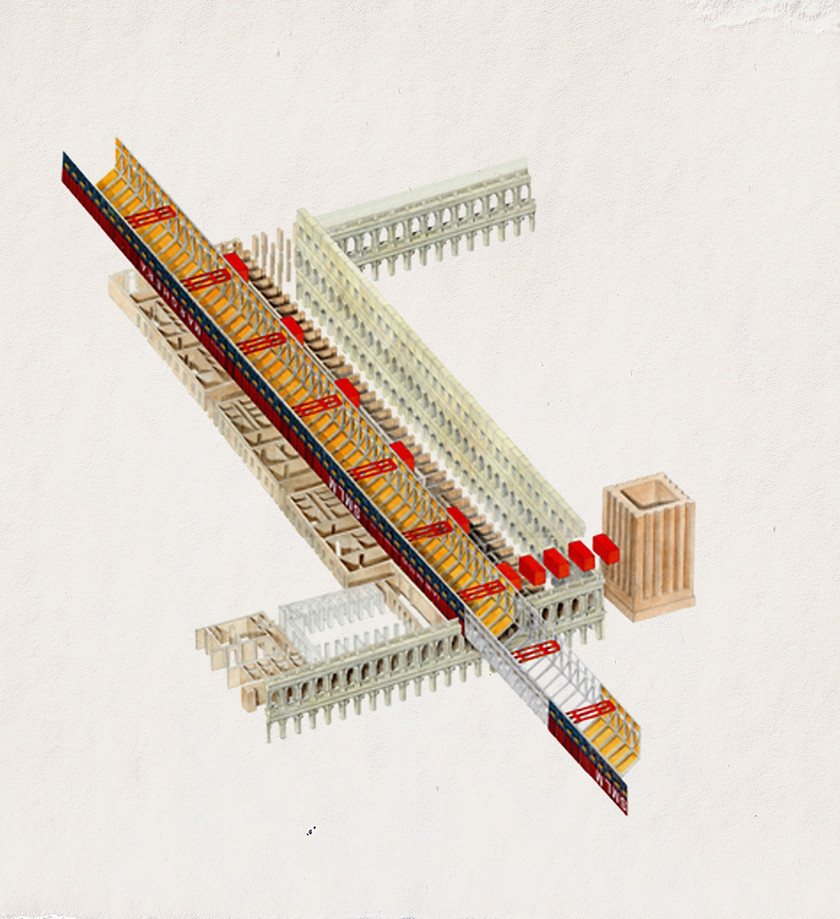
COMPOSIZIONE 1
2010 PENCIL, INK ON PAPER, 80 x 45